
What We Fail to See in Rothko


What makes a work of art a work of art?
Its technique? What it makes me feel? The price it reaches at auction? The number of people who pretend to have understood it?
While translating Péricles Gasparini’s book Cornici Alternative, Arte o Ribellione? into Italian, I found myself forced to ask these very questions. In the introduction, Gasparini wondered not only about the value of his own creations, but also what transforms an object into a work of art, and a work of art into something worth preserving. How much of that value belongs to the artist, and how much, instead, to the gaze that recognizes it?
These are questions I carried with me, and they echoed with surprising force in front of Mark Rothko’s monumental, imposing, almost unsettling canvases.
The artist, one might say, is born to be misunderstood, and there is no real argument against it. The best art is the kind that makes you doubt yourself, isn’t it?

I tend to think the most “worthy” art is the one that produces a kind of vertigo in the stomach. A wonder that feels like disorientation.
So when I arrived at Palazzo Strozzi in Florence, I was mentally prepared to be unbalanced by it all: anything, really, as long as I did not remain indifferent.
Spoiler: in front of those vast fields of yellow, red, and shadow, I may have expected to feel more.
But perhaps, as certain women with compromised self-esteem like to say, “the problem is me.”
And yet Rothko would likely have appreciated this reaction. In fact, he might have distrusted its opposite.
Because Mark Rothko did not want his paintings to be merely admired. He had little interest in someone thinking “beautiful colors” before moving on to the next room. He wanted something far more uncomfortable: a confrontation.

Walking through the works gathered at Palazzo Strozzi - the exhibition open until August 23, 2026, bringing together more than seventy pieces from some of the world’s most important museums, from the MoMA and the Metropolitan in New York to the Tate in London and the Centre Pompidou in Paris, tracing virtually the entirety of Rothko’s artistic trajectory from his early figurative work to the great fields of color that made him famous - I had the clearest realization that the true subject of his paintings is not color, but the viewer.
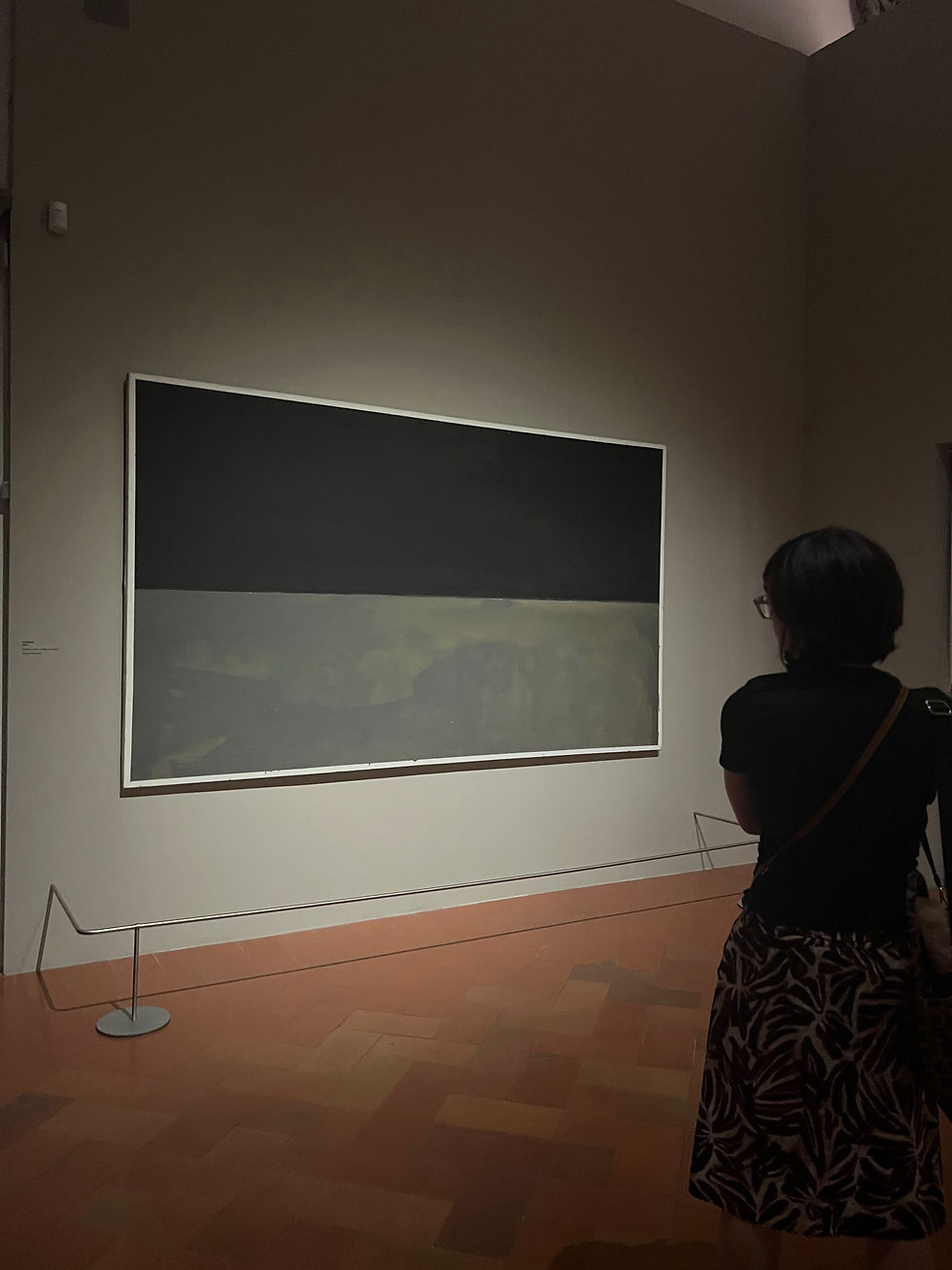
Rothko was born in Latvia as Marcus Rothkowitz and emigrated to the United States as a child. Over the course of his life, he lived through wars, migration, economic crises, and vast cultural upheavals. And yet, instead of painting the external world, he gradually stripped his canvases of almost everything: people, landscapes, objects, stories. What remained, in the end, was only color, light, and silence.
A slightly mad decision, if one thinks about it. As if a novelist had removed the plot just to see whether the reader would still stay.
In 1950, Rothko visited Florence with his wife Mell and was deeply moved by the frescoes of Fra Angelico at the Museum of San Marco, as well as by the vestibule of Michelangelo’s Laurentian Library. Palazzo Strozzi has structured part of the exhibition around this unexpected dialogue, extending it into the very spaces of the city that marked him so profoundly.
But what struck me most was not the mystical reading of Rothko so often repeated.
It was the mockery, the slap. I imagine it aimed especially at the elite dining rooms of the Four Seasons in New York. Not so much because his works were rejected, but because he himself withdrew them before they could become the backdrop to a thousand-dollar dinner. A gesture I find elegantly vindictive, infinitely more punk than most contemporary provocations.
I felt it in his canvases: the brazen transgression of a surface painted with almost religious care. As if to say, go on: see what you make of all this darkness.
As if to say: if you see nothing, perhaps it is you who are empty.
Perhaps this is also why Rothko continues to divide audiences. His work offers no handholds, tells no story, suggests nothing about what you are supposed to feel.
It leaves you alone in a room with yourself and a yellow rectangle as large as a wall.
And for many of us, that is already an extreme enough experience.
—
Bianca curates and writes for The Olive Press, a space for reflections on cinema, culture, and landscape born within Il Giardino di Cristina.


